Friday, February 27, 2015

My Anime History

Recently I picked up a Crunchyroll account so I could watch Sword Art Online.  But even though it's only $7 a month, it felt wasteful to watch only the one show.  So I've actually been watching quite a bit of anime lately.  And since I've got the urge to write again, I figured I'd just go with it.

Anime's been a part of my life since childhood, but I didn't realize it until high school.  That's because all the early anime I watched were American re-dubs of Japanese shows.  Battle of the Planets was originally Science Ninja Team Gatchaman, Starblazers came from Space Battleship Yamato, Voltron: Defender of the Universe was a merger of Beast King GoLion and Armoured Fleet Dirugger XV.  The king adaptation was also my favorite, Robotech.  That show took three completely unrelated series, The Super Dimension Fortress Macross, Super Dimension Cavalry Southern Cross, and Genesis Climber MOSPEADA, and rewrote them into one ongoing story.  Innocent child that I was, it never occurred to me that those shows were any different than the other cartoons I was watching like GI Joe or Transformers.  

Robotech.  Nobody does giant robots like the Japanese.

I did notice some differences, though.  The anime based shows tended to have better animation, for one thing.  More, the stories were a lot more adult in that there was romance, war, and death on most of the anime shows that was noticeably absent from their American contemporaries.  Certainly no episode of Robotech ever ended with "And knowing is half the battle!"

When I got to high school, my buddy Steve introduced me to the Anime Club.  That was the first time I'd heard the term, but I got the point quickly enough.  Anime was Japanese cartoons, the word a shortening of "animation".  While springing from Disney roots in the 1930s and then steered down a different path from western animation in the '60s by Osamu Tezuka, anime had developed it's own style and sensibilities that felt really fresh to my teen aged eyes.


Astroboy, Tezuka's classic character.  Another Japanese robot, albeit not a giant one.

I spent a couple hours a week from then on in a classroom watching bootleg videos of various anime with my classmates.  To be honest, I don't remember much of the shows from that time, with one exception.  When I was a young freshman, someone mentioned The Dirty Pair which sounded pretty interesting to a young man with raging hormones.  When I inquired further I was peremptorily informed that "you're not ready for The Dirty Pair" which only made me want to watch the damn show even more.   Eventually someone brought a tape with it on and we watched the antics of a pair of scantily clad girls who were pretty terrible at their jobs.  It was a fun little show, but not exactly the revelation I'd been expecting from all the build up.
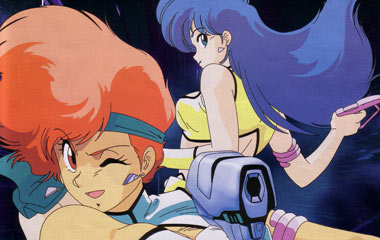

You're not...well, no, actually you probably are ready for The Dirty Pair.

The summer between my freshmen and sophomore years, I got into the bootlegging business myself.  I spent a month with my uncle in San Diego, and the video rental place near his house had a bunch of anime while he owned two VCRs.  I rented and copied hours of the stuff and returned to the Anime Club a minor hero for my efforts.  I also figured out that if you put your actual destination in the return address spot on an envelope with no stamp and drop it in a public mailbox, the Post Office will deliver it for free.  Video piracy and mail fraud all at the age of fourteen!  What can I say, it was that kind of summer.

I don't remember most of the shows I copied and the tapes themselves are long gone, but two did stick in my memory.  The first was Megazone 23, Part 2.  That was a cyberpunk style story reminiscent in many ways of the more famous Akira in that the hero is a motorcycle riding rebel in a tightly controlled technologically advanced society, though the stories go to vastly different places.  Megazone was notable because it was filmed in English with Japanese subtitles, which was a nice change of pace, as virtually all the Anime Club stuff was the other way around.  It also sticks in my mind because of the horrible, graphic violence.  It was one of, if not the, first times I can recall seeing people bloodily ripped apart on screen.  It made me queasy at the time, but not so queasy that it stopped me from sharing the video with my friends and younger brothers!


Don't be misled, even Megazone 23 Part 2 concludes in a giant robot fight.

The other show I recall was Gunbuster, which was a short six episode show about humanity in a war against giant bugs.  Naturally, this calls for the use of giant robots.  It also was the first time that I can recall seeing the Teenagers Save the World trope in anime, as the two main protagonists are both high school girls at the start of the show.  Gunbuster was also the first place I ran into the concept of time dilation from FTL travel, a concept that forms the core of the classic science fiction novel The Forever War by Joe Haldeman.  It was pretty deep stuff, even if Forever War handles it better.


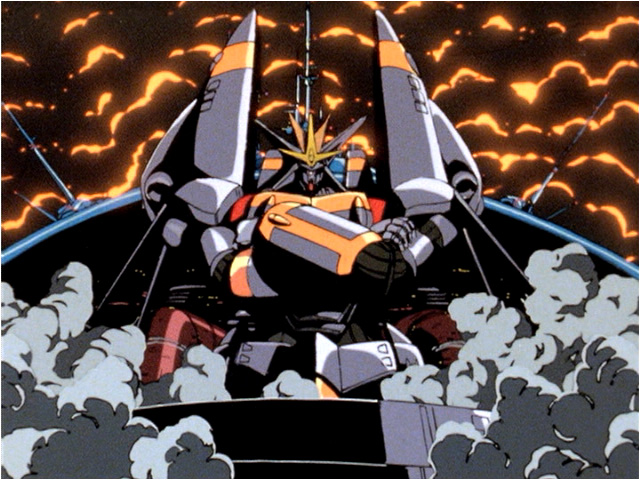
Gunbuster.  A giant robot.  Look, it was the '80s...

Eventually, though, I went to college and that was it for me and anime for a long time.  Without the resources of the Anime Club, long before video could be transmitted over the internet or Cartoon Network debuted Adult Swim, there wasn't an easy way for me to watch the stuff.  I went into a Ranma 1/2 phase in the late '90s, but that was an expensive habit since I was buying the show four episodes at a time on videotape.  I can recall seeing some Sailor Moon on TV now and again, and one of my friends threw a party where we all watched Perfect Blue.  A buddy and I got our hands on and watched all of Noir.  I saw Neon Genesis Evangelion at some point and got annoyed at the ending.  But that was pretty much it for decades.


Neon Genesis Evangelion: "Congratulations!"  Me: "What the fuck?"

Then, in 2012, I stumbled upon Crunchyroll, a web service that brings translated anime to the States.  Since then, I've found anime in many other places, including Funimation, Hulu, Netflix, and Amazon Prime.  Still, Crunchyroll remains my primary anime source and most of what I've watched recently came from there.  It was on  Crunchyroll that I saw Another, a show I wrote a review about, and Puella Magi Madoka Magica, which I did not but probably should have.   


Puella Magi Madoka Magica.  Looks cute, doesn't it?  It's a trap!
So that brings us to today.  In the last year or so I've watched something like a dozen anime series, and it's time to talk about them.  Some of them have a lot in common with some of the others.  These tropes and how they're used will be a core element of my forthcoming reviews.  We've already touched on one of those, the aforementioned Teenagers Save the World.  There will be others, but don't expect this to be a TV Tropes deal.  Identifying the parts that go into a show is not the end of criticism.  It's the beginning.  How those parts are used is even more important than what those parts are.

With that in mind, we'll start next time with the show that got me onto my current anime fix, Sword Art Online.

Friday, July 19, 2013

"Wyrd Sisters" A Theater Review

Purusant to my normal review policy, I'll have a brief non-Spoiler review at the top, followed by a more comprehensive Spoiler review after the poster.

Wyrd Sisters is an adaptation of a Terry Pratchett Discworld novel of the same name.  Unlike some of the other more Discworld intensive productions that the fledgling MorBacon Theater Company could have put on, however, Wyrd Sisters doesn't require you to have read that book or, indeed, any Dicworld book at all.  A passing familiarity with Macbeth, on the other hand, would be quite useful.

Terry Prachett's work is usually very funny, and Wyrd Sisters is no exception.  Translating the humor from the page to the stage takes effort, and I'm glad to say that in this case the work paid off.  Wyrd Sisters is good material competently executed.  If you're a fan of small theater and are in Chicago this weekend or next, you could do far worse than spend a couple of hours at the Side Project Theater with the Wyrd Sisters.


By the pricking of my thumb, something SPOILER this way comes!


When Burnham SPOILER comes to Dunsinane....

Wyrd Sisters puts me in an unusual position.  Normally, when you review adapted material you find yourself in one of two categories: you've read (or seen or played) the source material, or you haven't.  Indeed, many of my recent reviews deal heavily with a comparison between book and screen.  What's complicated about this review, however, is that while I did in fact read the book Wyrd Sisters, it was many years ago, and I only vaguely recalled that it had something to do with a play and witches.  I'm a Discworld fan, but my favorite books of Pratchett's are actually the Night Watch books like Guards, Guards! and Men at Arms.  And Good Omens, of course, which isn't Discworld at all.

That lack of memory about Wyrd Sisters worked to my advantage, however.  The play is, more than anything else, a comedy, and nothing ruins humor more than knowing the jokes ahead of time.  So from a personal enjoyment standpoint not remembering the book was perfect. It reduces my ability to compare the book to the play, of course, but that's an acceptable trade-off.

So rather than discuss how the translation to a play was handled, we'll just talk about the production itself.  First off, let me say that Wyrd Sisters was cannily chosen.   Not only, as I mentioned in the introduction, does the story not require any particular knowledge about Discworld or Pratchett's other works, but it also deals with the power of theater itself, which works exceptionally well in a theater setting.

The story, very broadly, is that of Macbeth as seen from the perspective of the three witches from the beginning of Shakespeare's work.  In that respect, as well as in the humorous approach they both take, Wyrd Sisters reminds me of another of my favorite works, Rosencrantz and Guildenstern are Dead.  Unlike that latter work, however, the witches in Wyrd Sisters aren't trapped by the Macbeth narrative the way poor doomed Rosencrantz and Guildenstern are in Hamlet.  Rather, the witches here become active participants in the goings on and, contrary to their own rules, start to meddle.  Hi-jinks ensue.

The acting varies from competent to excellent, with Susan Wingerter's Nanny Ogg in particular being almost exactly how I'd pictured her character from the books.  I also found Shantelle Szyper's Duke Felmet to be surprisingly sympathetic for the nominal villain of the piece, and the running gag about her hands was nicely played.  

That does bring up an interesting aspect to the production.  Wyrd Sisters has an all female cast, but doesn't make a big deal about that fact.  After a conversation with the production's artistic director, I learned that the all female cast wasn't a conscious decision to play it that way.  Instead, they opted to choose the best nine actors of the forty or so who auditioned, regardless of gender.  I'm told that, for whatever reason, the Chicago theater scene has far more female actors than male ones, and as such there are often better women available than men for any given production.  I'm not conversant enough with the local acting troupes to know if that's correct or not, but the decision to ignore gender as a factor in their casting has led Wyrd Sisters to become an even more poignant mirror to Macbeth.  After all, when Shakespeare's play from the perspective of the male murderer turned king was first performed, it was with an all male cast, with men playing the female roles.  How appropriate, then, that the opposing view as seen by the female witches should then have an all female cast?

The production is intimate and minimalist, by which we mean it is held in a small room with little in the way of complicated sets.  But that's alright.  It means that even someone in the furthest row of seats, as I myself was, is far closer to the action than anyone would normally expect in a larger and more expensive theater.  Anyone who's visited the Neo-Futurarium to see Too Much Light Makes the Baby Go Blind (I almost typed "blond" just there which would be a completely different thing) will be familiar with the small independent theater vibe.  Wyrd Sisters and the Side Project Theater shares a similar feel.

Overall, as I said in the spoiler-free version, this is a fun production.  For $15 you're getting a very good deal on some quality funny theater.  And if you're uncertain, I'm told that Thursday the 25th is pay what you can night.  If you're a fan of Shakespeare, Discworld, or just like a quick, funny show, and happen to be in or near Chicago this weekend or next, I'd recommend you take the time to go see Wyrd Sisters.

Wyrd Sisters is being performed at the Side Project Theater, 1439 W Jarvis Ave Chicago, IL, 60626, (773) 973-2150.  Shows are at 8 pm Thursday, Friday, and Saturday, and 2 pm on Sunday through July 27th.  Tickets can be purchased online here. 

Tuesday, July 2, 2013

"World War Z" a Movie Review

By request.  As usual, I'll be doing most of this review full of Spoilers.  The Spoiler-Free section is up here, the rest is after the poster.

Super-short review: Not as good as the book, but not bad for what it's trying to be.

Less short:  They avoid a lot of the usual zombie movie scenes and they spend more time giving you things to think about how a zombie apocalypse would happen, but there's still moments of movie stupidity and I think I can see the seams from the re-shoot they did.

Overall:  Not bad.  Worth seeing in the theater, especially if you've managed to avoid most of the marketing.  You'll get your details in the spoiler section below.

We're going to need to evac from these SPOILERS.


Ain't no wall big enough for them SPOILERS!

So let me start right out of the gate and admit that I not only read, well, technically listened to, the book World War Z: An Oral History of the Zombie War, but I loved it.  Writing what was essentially a historical telling of fictional events is one of those ideas I keep thinking about using myself, and doing it as an oral history so you still get the immediacy of a traditionally written story but can keep the detachment inherent in many non-fiction pieces was a brilliant touch.  Max Brooks did a great job with his book, and the fully voiced audiobook with a diverse cast is by far the best way to experience the story.

Indeed, I'm told there's an expanded version of the audiobook out now that includes scenes cut from the original that I'll have to track down one of these days.

World War Z the movie, however, is only broadly the story from the book.  For one thing, rather than being shot as a documentary after the fact as I would have done, it instead follows Brad Pitt's character around the globe as he investigates the zombie apocalypse in progress.  That's disappointing, because half of what makes World War Z:: An Oral History special is the way its structured and written as fictional non-fiction.  By forsaking that format, you're down to just the inspiration for the book, an earlier book also written by Brooks, The Zombie Survival Guide.

In The Zombie Survival Guide, they lay out rules for zombies and how to survive them.  Some of them, like Pitt's character wrapping his arm in a phone book to shield himself from zombie bites, actually made it into the film.  That points out something in the film's favor, that it's somewhat smarter than the average zombie film.  A lot of what humanity does to counter the zombies makes sense.  Moving as many people to ships as possible, for instance.  Or resettling into largely uninhabited areas to avoid large numbers of zombies for another.  Even though mistakes are made and battles lost, you at least get the feeling that people are trying to stay alive rather than the usual total collapse of civilization that one sees in more traditional zombie fare like  The Walking Dead and 28 Days Later.

Speaking of the later film, the zombies in World War Z the film resemble the fast moving ones from the 28 Days Later series more than they do the slowly shuffling ones in both The Walking Dead or, indeed, the original novel and The Zombie Survival Guide.  Indeed, there are times when the zombies are less individual attackers and more an irresistible wave of carnivorous flesh.  Those scenes really highlight the implacable nature of the enemy, and really work. The zombies don't have the any drop of blood can infect you aspect of the 28 films, however.  In another smart scene, Pitt's character finds that out when he gets some blood in his mouth and runs to the ledge of a rooftop, knowing that if he started to turn he'd fall off and spare his family from being attacked by him.  It's clever and well done, and I appreciate that level of thought in my zombie movie.

Unfortunately, the family represents a problem for the film.  It annoys me that, when facing global annihilation, we're supposed to care more because of a wife and a few kids.  The stakes are high enough, we don't need to know that Pitt's character, Gerry Lane, loves his family.  Every time we cut back to them it feels like we're wasting time that could be spent dealing with the zombie problem.

Furthermore, the usage of Lane's family as leverage to get him on the mission is Hollywood Dumb.  It's the end of the world, and that's all hands on deck time.  There's nothing Gerry can do staying on a warship with his family that will either help the world or protect his family any more than the armed personnel already will.  On the other hand, he legitimately has skills that could help the world out in the field.  For him to refuse to use those skills until the military pressures him through his family not only makes him less heroic for going out there, but makes him seem stupid and obstinate while also making the people in charge seem monstrous, which is redundant since there are actual monsters in the film!

What bothers me is that the trailers promise the opposite tack.  Presumably containing footage from before the re-shoots that delayed the movie's release, the trailer shows alternate versions of the same scenes where Gerry's wife actually supports his decision to try and save the world and the military commander doesn't threaten Gerry's family but rather more reasonably points out that Gerry and his family aren't immune to the end of the world.  If humanity dies out, they die with it.

I wanted to watch that movie instead of the one we got.

Which isn't to say that World War Z is a bad film.  It isn't.  I enjoyed much of it, and as there's word that a sequel has been greenlit, I expect I'll watch that one as well.  But I can't help but feel like this is an opportunity wasted.  This could have been, should have been, a better movie. What we got was pretty good, but it might have been very good or even great, and it wasn't.  Whether that failure comes from the re-shoots or even earlier when the decision was made to abandon the format that made the novel successful in favor of a more traditional Hollywood movie can never be known, but World War Z is missing a crucial something that keeps it from being special.

And that's a damn shame.

A couple of final notes.  First of all, if you've seen the trailers you've seen most of the big moments in the film.  While on one hand those scenes are impressive on the big screen, the sad part is, they lacked as much impact for me as they could have because I'd already seen them in the theater months ago.  Normally, I advise going to a theater only for big films and big moments, barring shows like Much Ado About Nothing where I'm investing with my dollars to support either a type of film (Shakespeare movies), or a creator (Joss Whedon), or both (Much Ado About Nothing).  Outside of things like that, I only go to the theater these days for spectacle where watching it on cable or on my laptop is a measurably inferior experience.  Hence I tend to watch a lot of the blockbusters and catch any smaller films at home later.

The problem with applying that standard to World War Z is that they didn't hold any of the big spectacle moments out of the trailer.  So if you're familiar with the trailer you've already seen the only moments that justify the $11 price tag.  If that's the case, it's hard to recommend this film for theater watching, although seeing those scenes in context is of course superior to watching it in isolation in a trailer.  If you haven't seen the trailer, or have seen it and forgotten it, it might still be worth the cash.

Secondly, there's a board game tie in to the film.  Unfortunately, reviews say it's kind of boring and that you should just play Pandemic instead.  Still, it exists.  So if you haven't had enough World War Z after you've seen the film, perhaps that's an option for you.  Here's the Vasel Review of the game if you'd like to see it for yourself.

So that's what I think.  Maybe the sequel will be better.

Monday, April 8, 2013

Doctor Who Review: Episode 7.8 "The Rings of Akhaten"

Spoiler free to start, spoilers after the poster.

Throughout Season Seven, Doctor Who has been trying to be explicitly "cinematic."  You can see it in "A Town Called Mercy" where Doctor Who does a Western, or "Dinosaurs on a Spaceship" where it's Who does Jurassic Park.

"The Rings of Akhaten" is Doctor Who does Indiana Jones.

No snickering, please.

As is pretty typical for the new series, whenever there's a new companion on the stage one almost always gets a companion-heavy episode either right out of the gate or as the second episode.  This time it's the second episode, as we start to get to know Clara as a character in of herself rather than just as the object of the Doctor's obsession.  How well does that work?  Not bad, even if the story itself is a little over the top for my tastes.  Details and spoilers after the poster.

Spoilers in Space!


Sing a Song of Spoilers!

Right, so we've got Clara now.  There's something funny going on here, because while Amy was an actual mother who we even got to see give birth, Amy never had a chance to be particularly maternal since her child was stolen within hours of her giving birth.  On the other hand, Clara, while not technically a mother in that she's never given birth to anyone, has had three out of her four stories so far emphasize how good she is taking care of kids.  In "The Snowmen" and "The Bells of St. John" she's a professional nanny, and here in "The Rings of Akhaten" she spends much of the episode as a surrogate mother for Merry.  

So we have a companion whose motherly aspects are being highlighted and then, all of a sudden, the Doctor explicitly mentions his granddaughter for the first time in decades?  I'm beginning to suspect at the Doctor may actually try to fulfill his vow (see below) in the 50th anniversary special.


Wouldn't that be something to see?  Personally, I can't think of a better way to commemorate 50 years than with a resolution to one of the longest running unresolved plotlines in the show's history.  It took them twenty years to give Sarah Jane Smith the resolution she deserved, while Susan's been waiting for nigh on half a century!

Going back to this week's episode, I enjoyed it.  There was some derring-do mixed in with Clara taking care of Merry, the bit with the door being particularly funny.  The visuals were glorious, especially of the various planetoids in the rings.  We got to know more about Clara, fulfilling the episode's brief, and got some alien world fun.  So why do I find myself somewhat lacking in enthusiasm for this episode?

Well for one thing, watching the show live on BBC America kind of sucks.  The commercials break the flow of the show, especially since I'm used to seeing commercial free versions on Netflix or on DVD.  I also can't get over the fear that scenes may be getting cut short or eliminated entirely on the BBCA version, since I've seen re-runs there that are definitely missing scenes I remember from DVD versions I own.

Beyond that, though, is the fact that I didn't buy the ending.  A leaf with the power of the infinite?  Even with the setup of "things we value become valuable" from the rent the skybike scene, I still wasn't getting it.  It felt hokey to me, too much like all those "the power of love conquers all" stories where you can literally turn love into a demon destroying energy beam or fire ball.  I'm just not buying it.

Nevertheless, the episode served its purpose and rolled the plot forward a bit.  It was fun, if not especially deep.  Good enough for now, but I'll want something with more meat on the bone before this season is through.

Friday, April 5, 2013

Missing Roger and Gene

There are no shortage of eulogies to Roger Ebert available today.  You can read Grantland's long form essay on Ebert's career, or MovieBob's tribute with embedded videos.  For my money, the best one out there is James Berarnadelli's eulogy for Roger on his site, ReelViews.  Berarnadelli, you see, knew Roger personally, and thus has lost a friend rather than just a colleague or respected journalist.

My own perspective is somewhat different.  You see, while I have done a few movie reviews here and there, I can't really call myself a real movie critic by any means.  No, my point of view is a local one.  As a Chicagoan, by which I mean someone who's lived in Chicagoland most of his life if not in the city proper, Roger Ebert and Gene Siskel were ours long before they were the nation's.  I watched Sneak Previews as a kid long before Roger and Gene went national with At the Movies.  Reflected glory though it may have been, Chicagoans have always been proud that the two most well known and respected movie critics emerged on the shores of Lake Michigan rather than in LA or New York as one might otherwise expect.

What's more, for all that the TV shows were national, and Roger's numerous books were available everywhere, their actual reviews were to be found in the Chicago Tribune and the Chicago Sun-Times.  And even if anyone could go to the Sun-Times site to read Roger's reviews in recent years, only someone from Chicago could hold them in his hands.

Gene and Roger.  Siskel & Ebert.  They were ours before they were the world's, and I will miss them both terribly.

The balcony is closed.

Thursday, April 4, 2013

White Sox Over the Royals 5-2

You may or may not have noticed I failed to post yesterday.  That was because I was off at the White Sox game yesterday, which ate up most of my productive writing time.  But hey, every ballgame is an opportunity, right?  So let's talk about what it's like to watch baseball in Chicago in early April.

It's cold, that's what its like.

Fortunately, this ain't my first rodeo, so I dressed appropriately.  And we were informed by an usher that, since our seats were in the shade along the third base line, that we were free to move to stay in the sunlight.  That was completely unexpected, as most ballparks I've ever attended were pretty up in arms about stopping "Seat Weasels" from buying the cheapest possible seats and then moving to unoccupied good seats.

But then again, when you've got attendance like this...


...I guess the only rational thing to do is see to the comfort of whomever bothered to show up.

Either the temperature, or the relative lack of a crowd, or both had an effect on the enthusiasm of the fans present.  There wasn't that much in the way of cheering, even when the White Sox pulled out to an early lead.  

Still, it was an enjoyable game.  Despite Dayan Viciedo's butchery in left field (he had two errors, one of which led to a Kansas City run), the Sox provided more than enough firepower to get the lead and keep it.  Jake Peavy was in good form on the mound, and it was interesting to see Sox manager Robin Ventura cycle pitchers in and out in the late innings nearly on a batter by batter basis.  Ventura used six pitchers yesterday, of whom only Peavy and closer Addison Reed retired more than two batters.

As far as the rest of the experience, it was nice.  The food was good, as always.  I love the polish sausage with the grilled onions.  The fries were good but chilled to inedibility too fast in the cold weather.  I should have gotten chips or popcorn instead.  Of course, you are paying movie theater prices for the privilege, but you have to expect that going in.

Indeed, I think we paid more for the food than we did for the tickets.  I filled out a survey on WhiteSox.com and they gave me a discount on the tickets.  So for $12 a ticket (which went up to $18/ticket after various fees were attached) two of us went to the game.  Not bad for an afternoon's relaxation.

All that said, I think I'll wait until its warmer to go back.  The wind was particularly biting, and my gloves were insufficient to the task of keeping my fingers warm.  I'm thinking June or July, perhaps.

Until then, I can watch it on TV.  As indeed I am right this moment as I finish this post.  Multi-tasking is fun. 

Tuesday, April 2, 2013

Game of Thrones Review: Episode 3.1 "Valar Dohaeris"

As usual, I'll be doing a very brief non-SPOILER review, then a full review after the poster.  You have been warned.


Game of Thrones is a pretty hard show to review on an episode by episode basis.  After all, excepting big event episodes like last years "Blackwater", Game of Thrones really doesn't have much in the way of distinct episodes.  I mean, yes, each one begins on some kind of stinger and ends on a big event or cliffhanger, but there's almost never a coherent plot that begins and ends in the same episode, "Blackwater" excepted.  No, most Game of Thrones episodes just pick up the ball and run it a few yards forward, then hand off to the next episode.  Which is fine, since they're telling one very long story of which this is only a tiny fraction.

It does make reviewing that fraction on its own a pain in the ass, though.


The short, non-spoiler version is that this episode is a pause for breath.  It's talky, with very little action.  It's giving you a chance to catch up with about two thirds of the cast as they each start something new.    There is, of course, no such thing as a disposable episode of Game of Thrones.  If you want to watch the show, you have to watch them all, and in order.  So a blind recommendation like this is pretty worthless.  Nevertheless, the episode is a necessary one even if not all that much happens in it.  Much of the rest of the season is being set up here and, presumably, the next episode as well.

Our House words?  "Here there be SPOILERS"

  
Come for the ale, stay for the SPOILERS.

As I discussed above, Game of Thrones doesn't really do the traditional TV structure.  Compare this show to, say, Babylon 5, which had a long story to tell, but did it over five seasons of regularly structured TV.  That is, each episode of Babylon 5 could be viewed on its own as a stand alone work.  Granted, you wouldn't get as much out of each episode if you didn't watch the others, but each epiosde still had a regular structure.  There was a main plot that began and was resolved over the course of that episode.  Often, as is common on shows with large casts, B5 would have a secondary plot as well where we saw what the characters not involved in the main plot were up to.  That plot would also be resolved by the end of the episode.  Most Babylon 5 episodes had a typical A-Plot/B-Plot structure, with the main plot being hinted at or advanced in some small way during one plot or the other.  The exceptions were what showrunner J. Michael Straczynski called "Wham" episodes, where he takes a crowbar and "whams" the plot onto a different course.  Those episodes were the ones that most fans really remember, and they are the ones that have the most in common with Game of Thrones, which does Wham episodes as well.  The death of Ned Stark and the Battle of Blackwater were both serious Wham episodes, after all.  But in contrast to the way Babylon 5 approached episodic content, Game of Thrones takes a different model.  

Game of Thrones uses soap opera structure.  

If you look at it, very rarely do you see a plot begin and end in the same episode.  Instead, we see plots start and stop throughout the series.  Sometimes they go a season, sometimes they go only a few episodes, sometimes they go on and on.  Each episode touches on a few of the various plots, moving each one forward.  Sometimes the plots run into one another and new plots form, while sometimes (especially with Daenerys off on another continent) they stay separate from everything else.  But still, the structure is there.  Game of Thrones is a soap opera with swords, bared breasts, and dragons.

That's not a bad thing, mind you, but it does mean that rather than a chronological look at events, it makes more sense to just track each plotline individually.  So let's do that.

Beyond the Wall there are two plotlines going on.  First, there's what's left of the Night's Watch on the run from ice zombies.  In the other, Jon Snow's making an ass of himself with the Wildings.  Of the former, there's not much to say, since it's only to establish that you can kill the zombies with a torch and that, contrary to the books where Sam gets his first hero moment, HBO's Sam failed to even get the ravens sent.  Which, honestly, makes more sense from a dramatic point of view, because it means that the Night's Watch are racing back to the Wall to try and warn the world rather than just hoofing it to save their own asses, as in the book.  Sucks to be Sam.

But not as much as it sucks to be Jon.  Because, as always, we get another "you know nothing, Jon Snow " moment.  Poor Jon can't help fucking it up, no matter how hard he tries.  They're going to have to work hard to elevate Jon to a hero position at this rate, because so far we've only seen him as a moody, petulant fuck-up.  Even the moments of coolness he should have had in the first couple of books were downplayed or rendered accidental, while the ways in which he sucks have been magnified.  Alas, poor Jon.

Of course at least he gets some reasonably significant screen time.  Robb only gets a few moments taking an abandoned Harrenhall, and Catelyn is shown but gets no lines.  And even that is more than Arya or Bran get, as they aren't even in this episode.  Neither is Jamie Lannister and his warrior maiden escort, for that matter. Indeed, pretty much the only other Stark besides Jon who gets any real screen time is Sansa in her golden cage at King's Landing.

Sansa, of course, has gone from pining for marriage to Joffrey and becoming Queen to pining for escape to anywhere. Being possessed of very poor decision making skills, she opts to put her trust in a man who was obsessed with her mother and betrayed her father, leading to his death.  I'm sure he's helping you out of altruism and things will go swimmingly for you, Sansa.

Meanwhile, as Sansa books a trip to Fantasy Island, Tyrion is getting the Cold Hard Reality Fish slapped into his face.  Fact of the matter is that Cersi still hates you but you no longer have the power and resources to fuck with her the way you did last season.  Oh, and your father hates you too and you're never getting your rightful inheritance.  You can almost hear the wheels turning in Tyrion's head calling for revenge, and Dinklage does an excellent job with his barely suppressed and totally righteous rage.  As much as I enjoyed Tyrion's rise last season, seeing how he handles is fall should be as good or better.

Someone who's on the rise is Margaery Tyrell.  Having replaced Sansa as Joffrey's Queen-to-Be, Margaery is making more of an effort to win the love of the people than Joffrey ever has.  Is it a ploy to gain power through the people?  Is it genuine concern for her subjects?  Both?  Hard to say how they're playing her in this version just yet, but I'm enjoying the way she's interacting with Joffrey and Cersi.

The poor Onion Knight, Ser Davos Seaworth, on the other hand, isn't enjoying life.  His ship and son were blown up, he's burned and missing fingers, and his boss has tossed him in the dungeon because the crazy fire priestess is ascendant.  This is actually a bit of an acceleration over events in the book, but not a bad one given the time constraints they're under.  I expect that this particular plotline probably won't change much from the published version.

Finally, we get to Daenerys.  In another acceleration, she's already made it to Astapor, the first of the three cities on Slave Bay.  Here, she's disgusted by the way slavery is practiced even as she contemplates buy hundreds or thousands of them to fight her war for her.  Compassion or pragmatism?  What will the Stormborn choose?  And will her new knight who appears at the end of the episode, Ser Barriston Selmy who took all of last season off to find her.  So now Dany has two advisers, one practical and ruthless, the other noble and virtuous.  Which impulse will she follow in Astapor?

So that's where we stand one episode into Season Three.  Presumably, we'll be catching up with the characters on the run (Arya, Bran, Jamie) and see what's going on in Winterfell now that Theon's boys decided to take a hike.

It should be fun.